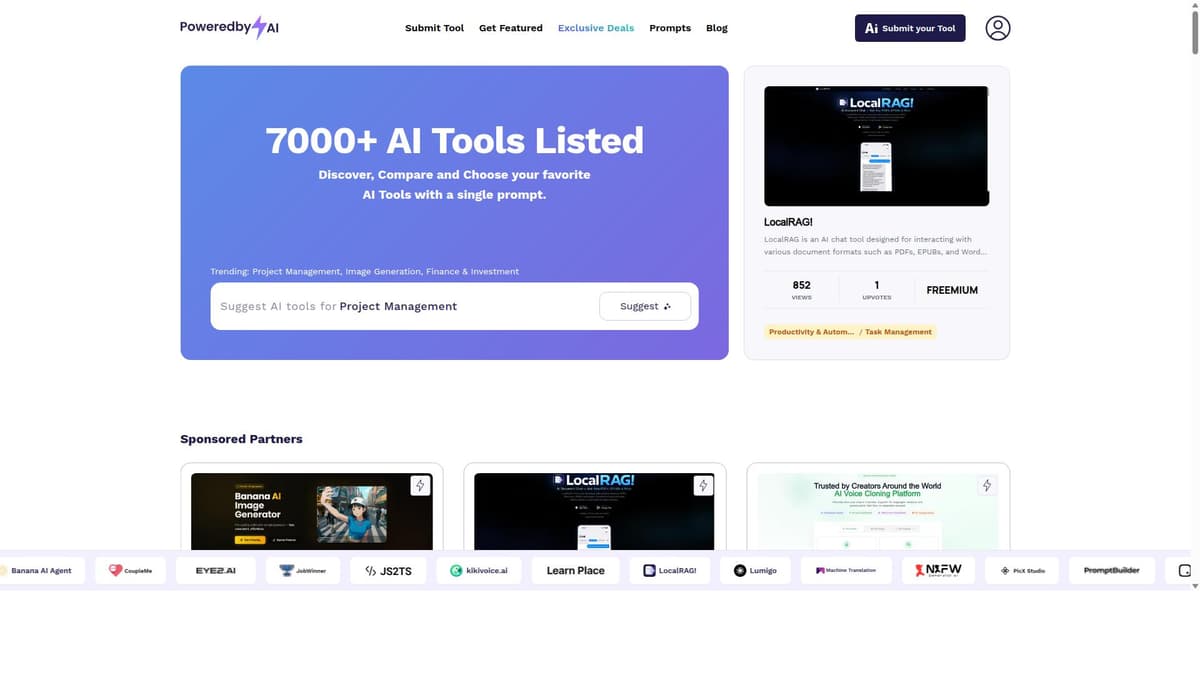
10,000+ AI Tools Listed
Discover, Compare and Choose your favorite
AI Tools with a single prompt.
Trending: Project Management, Image Generation, Finance & Investment
AI Styling Studio — Infinite avatar looks from just 1 photo. Try it now.
Discover, Compare and Choose your favorite
AI Tools with a single prompt.
Trending: Project Management, Image Generation, Finance & Investment

Across the industry, companies are starting to balk at the price of AI.Uber blew throughits entire 2026 AI coding budget by April.Microsoft revokedits developers’ Claude Code licenses months after enabling them. A Priceline employee told TechCrunch that a routine Cursor contract renewal came back 4-5x more expensive. Even though per-token prices have fallen, the push for more AI adoption and increasingly autonomous agents have driven token consumption higher and higher. Companies that gorged themselves in early 2025 on all-you-can-eat subscriptions are now scrambling to understand where their money is going, pull back spending, and figure out whether they can salvage some ROI from the wreckage of their budgets. Meanwhile, a market is forming to meet them there. Startups, established vendors, and a new standards body are all racing to give companies the tools and language to track what they spend. “Six months ago, I would have a conversation with a customer and it would be all about ‘What can it do? Is it good enough?’” Alexander Embiricos, OpenAI’s head of enterprise, told TechCrunch at an event in New York City this week. “Our conversations are never about that now. Now the conversations are about, ‘hey, we’re spending so much. What visibility do you have? What auditability do you have? What token controls do you have? What is the efficiency of your models?’” It’s against this backdrop that the Linux Foundation this week unveiled plans for the Tokenomics Foundation, a new standards body that aims to instill the same cost discipline around AI tokens that FinOps did for cloud spend. “In April and May, I started hearing from companies: ‘Oh my god, we are 3x over our entire 2026 token budget and it’s only April,’” J.R. Storment, executive director of the FinOps Foundation, a project under the Linux Foundation, told TechCrunch. “We started hearing existential crises, and the whole conversation shifted fromtokenmaxxingand ‘go fast’ to ‘we need guardrails, how do we control this?’” The cries heard round the tech world followed fervent demands from CEOs pushing their teams to use the best models and move fast, costs be damned. New models released in November like Anthropic’s Claude Opus 4.5, OpenAI’s GPT-5.1, and Google’s Gemini 3 Pro brought significant improvements to agentic tools, which have multiplied consumption. It’s how one companyreportedlyfound itself with a $500 million Claude bill after forgetting to set usage limits for employees. “It’s like the crack-cocaine epidemic,” said Chris Reed, senior director of IT finance at Priceline, noting the company had begun placing token limits on certain groups. “They let you try it to get you hooked on it, and now you’re kind of beholden to it.” Vitaly Gordon, CEO of engineering operations platform Faros AI, said he recently spoke to a CTO who told him: “One of my engineers spent $40,000 on tokens last month, and I genuinely don’t know whether I should stop him or should I go and tell everyone else to be like him.“ A Marchsurveyby Faros found that among 20,000 developers, output was rising, but so were bugs and rewrites. Jellyfish, an engineering management platform, similarly found engineers who used the most tokens were about twice as productive as those who used AI less, but they spent 10x the number of tokens to get there. Nicholas Arcolano, head of research at Jellyfish, told TechCrunch via email that expenditure on AI is exploding in large part due to agentic features, with per-developer consumption rising about 18.6x in nine months. All in all, these stats make the productivity case murkier than the spending suggests. “Whether extreme spend pays off comes down to the ultimate business value of shipped code (e.g. revenue), which most companies still can’t measure,” Arcolano said. At least some of that measurement issue is the sheer scale at which AI is being used today. “Tracking cloud costs is a hundreds-of-millions-of-rows-a-month data problem,” Storment said. “Tracking token costs is a trillions-of-rows-a-month data problem. You can’t just stick that into whatever spreadsheet or even basic tool. You’ve got to fundamentally rethink your tooling, your specs and your accounting systems to do that.” At Priceline, Reed is already seeing discrepancies. He noted issues between a vendor’s reported usage and Priceline’s internal data. “I started my career in telecom expense management, and I’m seeing all the same parallels, from telecom to cloud to AI,” he said. “Anytime you introduce something new, it’s ripe for billing errors and audit and optimization opportunities.” A market is beginning to form around this problem. There are the pure-play companies, like Pay-i, which tracks, measures, and optimizes the costs and performance of GenAI investments.Paid, meanwhile, lets developers track costs, measure usage, and bill users based on actual value rather than subscription fees. Then there are companies like Jellyfish, Waydev, and Faros AI, which all provide AI agent monitoring to prove the ROI of developer tools. Storment says most of the 180 vendors within the FinOps Foundation are leaning toward this space. Companies with existing distribution are also adding new features to capitalize on this new market. Ramp has recently moved intoAI spend management;DatadogandNew Relichave tacked on services like cloud cost management, token-level observability, and GPU monitoring. At the FinOps X conference next week, AWS is expected to introduce new financial management features geared toward enterprise AI spending. Tiffany Luck, a partner at NEA, thinks token efficiency and observability will likely be added in at the “harness or app layer.” She pointed to Factory, astartupthat makes AI agents for enterprises, which this weeklauncheda model router that automatically picks the right model for every task. Gordon expects frontier labs and other model providers to adopt OpenRouter-style optimization to drive queries to the cheapest models — a trend already showing up on enterprise Claude bills. “The financial report for how much you spend on Anthropic, even if you call the Opus model, some of the spend will be on Sonnet or Haiku, because they are smart enough to do it,” Gordon said. “I think this will become more and more of a thing.” But all these tools are being built without a common language or shared definitions for how much a token costs, what it produces, and how to compare spend across vendors. That’s where the Tokenomics Foundation hopes to prove useful. The Foundation is building a canonical definition and framework for “tokenomics;” open standards, specifications and metrics for AI token usage and billing; as well as new metrics for AI economics, like cost-per-intelligence or tokens-per-watt. It also plans to define metrics across token factory effectiveness and consumption efficiency. The group is planning a formal launch in July, and is about to announce more members at the FinOps X conference next week. “Token economics is fundamentally more abstract and opaque than anything we’ve managed at this scale before,” Nishant Gupta, chief availability officer at Salesforce, said in a statement. “It requires a different operational muscle than the one the industry built for cloud.” That said, Goldman Sachsprojectsglobal token usage to multiply by 24 times by 2030. The companies already over budget need solutions now, and the foundation’s first deliverable is still months away. “Maybe we created a steam engine, but we still haven’t figured out the assembly line,” said Gordon. According to Arcolano, the smart move is broad, moderate adoption. “The best ROI comes from moving the broad middle from low to moderate usage, not pushing heavy users higher,” he said. Russell Brandom and Tim Fernholz contributed to this reporting.
View

Loading the player… While the AI fundraising machinekeeps breaking its own records, some founders are building in the other direction. Mirror founder Brynn Putnam just raised money forBoard, a startup focused on bringing people together through in-person games and social experiences.Cyberdeck creators are going viralcrafting whimsical DIY computers that literally encourage users to touch grass. Unlike theAI-free browser crowd, this doesn’t just feel like backlash, but also people genuinely gravitating toward things that feel a little more human. WatchEquitypodcast hosts Kirsten Korosec, Anthony Ha, and Sean O’Kane dig into the week’s headlines, from the “together tech” wave to what Anthropic’s confidential IPO filing means against the backdrop of Alphabet’s $80 billion AI raise, and whether the money is all flowing back to the big guys anyway. Subscribe to Equity onYouTube,Apple Podcasts,Overcast,Spotifyand all the casts. You also can follow Equity onXandThreads, at @EquityPod.
View

OpenAI has announced a major upgrade to ChatGPT's memory capabilities, allowing the chatbot to make better use of information from previous conversations. The update aims to improve how ChatGPT remembers user preferences, ongoing projects, and personal details over time. OpenAI said the changes are intended to address issues such as outdated memories while making the feature more effective for a growing user base. The new system is built on a redesigned architecture that the company says can manage memory more efficiently at scale.
View

Blackstone-backed data center operator AirTrunk said on Thursday it would invest $30 billion in India by 2030, adding to a wave of commitments from technology and infrastructure groups seeking to expand computing capacity in the country. The Australian companysaidit would develop 5 gigawatts of new data center capacity in India, one of the largest commitments to the South Asian nation’s digital infrastructure sector. AirTrunk entered India earlier this year through the acquisition of Lumina CloudInfra. AirTrunk’s commitment underlines India’s growing appeal as a destination for AI infrastructure, as tech companies and investors seek new geographies to expand computing capacity. Data center capacity in the country isprojected to riseto as much as 8GW by 2030 from about 1.5GW today, according to research firm Bernstein. The Indian government has also taken steps to attract investment in AI infrastructure. Earlier this year, New Delhi offered foreign cloud providerstax exemptions through 2047on services sold overseas if those workloads are run from Indian data centers. AirTrunk has already begun laying the groundwork for its expansion in the country. Earlier this week, Maharashtra Chief Minister Devendra Fadnavissaid in a post on Xthat the western Indian state had exchanged a letter of intent for land allotment at the Raigad Pen Growth Center, where AirTrunk is planning a 3GW data center involving an investment of about ₹2 trillion (around $21 billion). The company already has a development pipeline of about 600MW across Mumbai, Chennai and Hyderabad. AirTrunk did not respond to questions on whether the proposed Raigad project would account for most of the planned 5GW capacity, or whether it plans to make additional developments elsewhere in India. The announcement follows a meeting between AirTrunk CEO Robin Khuda and Prime Minister Narendra Modi, whosaid in a post on Xthat the planned investment would help strengthen India’s position as a global hub for cloud computing and artificial intelligence. AirTrunk joins a growing list of companies investing in infrastructure in the country.Amazon,Google,Microsoft,OpenAI, andUberhave announced major investments in cloud and AI infrastructure, while Indian companiesReliance Industries,Adani Group, andTCShave laid out ambitious plans to expand data center capacity. However, data centers require vast amounts of electricity, water and land, and industry executives and analysts have pointed to resource issues as a potential bottleneck, particularly regarding power. Deloitteestimatesdata center build-outs in the Asia Pacific could require tens of terawatt-hours of additional electricity by the end of the decade. AirTrunk’s investment thesis is underpinned by government support, a large pool of technical talent, and access to renewable energy, Khuda said.
View
Showcase your AI tool to 100,000+ annual visitors actively exploring AI products.
Finding the Right Platform for Your Online Business
13 hours ago • 4 minutes 34 seconds
How AI Funnel Builders Are Changing Sales Funnels for Small Businesses
1 day ago • 5 minutes 22 seconds
Top AI Marketing Tools to Scale Content and Campaigns in 2026
1 day ago • 1 minute 55 seconds
ChatGPT vs Claude vs Gemini vs Llama: Full Comparison 2026
1 day ago • 2 minutes 37 seconds
Browse or search the directory by category, use case, or keyword. Each tool page includes a description, pricing model, and a direct link to get started. Create a free account to save favorites and track tools you want to revisit.
PoweredbyAI is not an AI tool itself — it is a curated directory of 10,000+ AI tools, updated daily. We cover every category from writing and image generation to coding and automation, with verified listings, user reviews, and exclusive discounts negotiated directly with vendors.
The directory is updated daily. New tools submitted by developers are reviewed and listed within 24–48 hours. We also monitor existing listings for pricing changes, feature updates, and tool shutdowns so the information stays accurate.
Yes. The Exclusive Deals section features verified discounts and lifetime deals from AI tool providers. Deals are negotiated directly with vendors and refreshed regularly. Some deals are only available through PoweredbyAI and cannot be found on the tools' own websites.
Yes, browsing the directory is completely free. You can search tools, read descriptions, and access deals without creating an account. A free account unlocks the ability to save favorites and submit tools for listing.
Click the Submit Tool link in the navigation bar and fill out the submission form with your tool's name, category, description, and pricing. Submissions are reviewed within 24–48 hours. Featured and promoted placement options are also available for additional visibility.
Our community and staff are here to help!
Your feedback will help Alice AI improve in future versions.







Submit your Tool
PoweredByAI.app is an AI Tools Directory helping individuals, businesses, and creators discover the best AI tools for writing, coding, design, productivity, and more.
© 2026 , Product of011BQ. All rights reserved.